
Consider a youth vaping prevention campaign in a rural community.
The public health research is well established. We understand the tobacco industry’s history. And there’s a potentially powerful creative strategy in the idea that nicotine addiction isn’t simply an unfortunate consequence of the business model. It’s part of the business model.
Imagine turning that idea directly toward young people: Addiction was part of their plan. You fell for it.
We think there’s something there.
Which is usually about the time communications people need to become a little suspicious of themselves.
Because we aren’t the audience.
So what if we put the idea in front of a focus group?

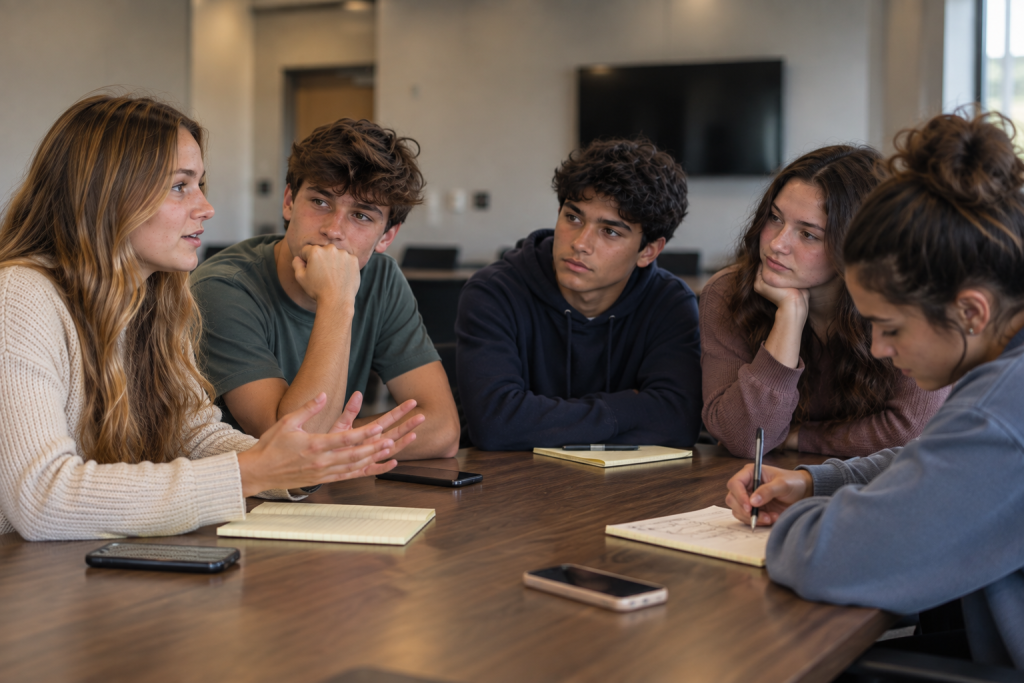
We assemble participants representing different young people we might be trying to reach: a 16-year-old who vapes regularly and doesn’t think much about it; a student athlete who sees friends vaping but hasn’t started; an 18-year-old who has tried unsuccessfully to quit; and a teenager living outside town who thinks vaping is simply something everybody around her vapes or smokes.
Then we start asking questions.
What does this campaign say to you? Do you believe it? Does it piss you off? Is “you fell for it” provocative or condescending? Would you stop long enough to pay attention? What would your friends say?
We push back on their answers. Change the language. Ask follow-up questions. Introduce different ideas and ask them to react.
There’s just one unusual thing about this focus group.
None of these teenagers actually exist.
A synthetic focus group uses AI to simulate a group of carefully defined audience members and explore how they might react to a message, campaign concept or creative idea.
 We can ask questions, probe reactions, introduce different concepts and look for potential blind spots or unintended interpretations, much as we would in a traditional focus group.
What makes that useful is speed, cost and the opportunity to challenge our own assumptions before we become too invested in an idea. We can test different messages, identify language that may confuse or alienate an audience, explore how different types of people might react and uncover questions we hadn’t thought to ask.
There’s also a pretty dramatic difference in logistics. A traditional focus group might cost several thousand dollars and take three to six weeks to recruit, schedule, conduct and analyze. A synthetic version can provide an initial round of exploration in minutes, at essentially no incremental cost.
That doesn’t make it better than talking to real people. But it can be a remarkably efficient way to pressure-test our thinking and determine what deserves deeper exploration.
There’s a very important catch
Our synthetic 16-year-old has never vaped, lived in a rural community or tried to quit nicotine.
 She isn’t a person.
Synthetic focus groups can reinforce assumptions and produce very convincing responses that don’t necessarily reflect what real people think. So if a synthetic group prefers Concept A, we would never report that “rural teenagers preferred Concept A.”
We didn’t ask rural teenagers.
That’s why this is a complement to traditional research and community engagement, not a replacement for them.
We’re interested in adding another tool to the process.
A synthetic focus group can expose weaknesses, identify questions worth asking real people and let us explore different directions while changing course is still easy.
And that’s what interests us most about where these technologies are headed.
If you’re only using ChatGPT to write emails, summarize meetings or draft social media posts, you’re using a powerful technology to make familiar tasks a little faster.
Useful, certainly.
But there are much more interesting possibilities.
Sometimes that might even mean inviting a few people who don’t exist to take a seat at the table.
P.S. A word about AI and transparency. Primeau-Fahey was among the first firms in our space to publish an AI disclosure policy. We believe that matters even more as these tools become more sophisticated and more deeply integrated into communications work. Our clients should understand where and how we use AI, where we don’t, and where human judgment remains essential. You can read our AI disclosure policy [here].